Approximately half of all heart attacks occur in people with "normal" cholesterol levels.
How is that possible? The answer lies in what standard cholesterol tests don't measure.
As a board-certified clinical lipidologist (DABCL), I specialize in understanding the complex world of blood lipids. And I can tell you that the standard cholesterol panel your doctor orders is just the tip of the iceberg.
What Standard Cholesterol Tests Measure
When you get a typical lipid panel, you'll see these values:
- Total Cholesterol - the sum of all cholesterol in your blood
- LDL-C (LDL Cholesterol) - often called "bad" cholesterol
- HDL-C (HDL Cholesterol) - often called "good" cholesterol
- Triglycerides - a type of fat in your blood
- VLDL - very low-density lipoprotein (sometimes calculated)
These markers are useful screening tools. But they're like looking at a photograph of a house to determine if it's structurally sound - you can see the surface, but you miss what's happening inside the walls.
| What's Measured | Standard Panel | Advanced Panel |
|---|---|---|
| Basic cholesterol | ✓ | ✓ |
| LDL particle number | ✗ | ✓ |
| LDL particle size | ✗ | ✓ |
| Lipoprotein(a) | ✗ | ✓ |
| ApoB | ✗ | ✓ |
| Inflammatory markers | ✗ | ✓ |
| Insulin resistance markers | ✗ | ✓ |
| Total markers measured | 4-5 | 15+ |
← Swipe to see more →
The Problem with LDL Cholesterol Alone
LDL-C measures the amount of cholesterol carried by LDL particles. But here's what matters more for heart disease risk: how many LDL particles are carrying that cholesterol.
Think of it this way:
- Imagine two people need to transport 100 tennis balls
- Person A uses 100 small bags (one ball each)
- Person B uses 10 large bags (10 balls each)
Both transport the same amount (100 balls), but Person A makes 100 trips while Person B makes only 10. In cardiovascular terms, more particles = more "trips" = more opportunities for particles to embed in artery walls and cause plaque.
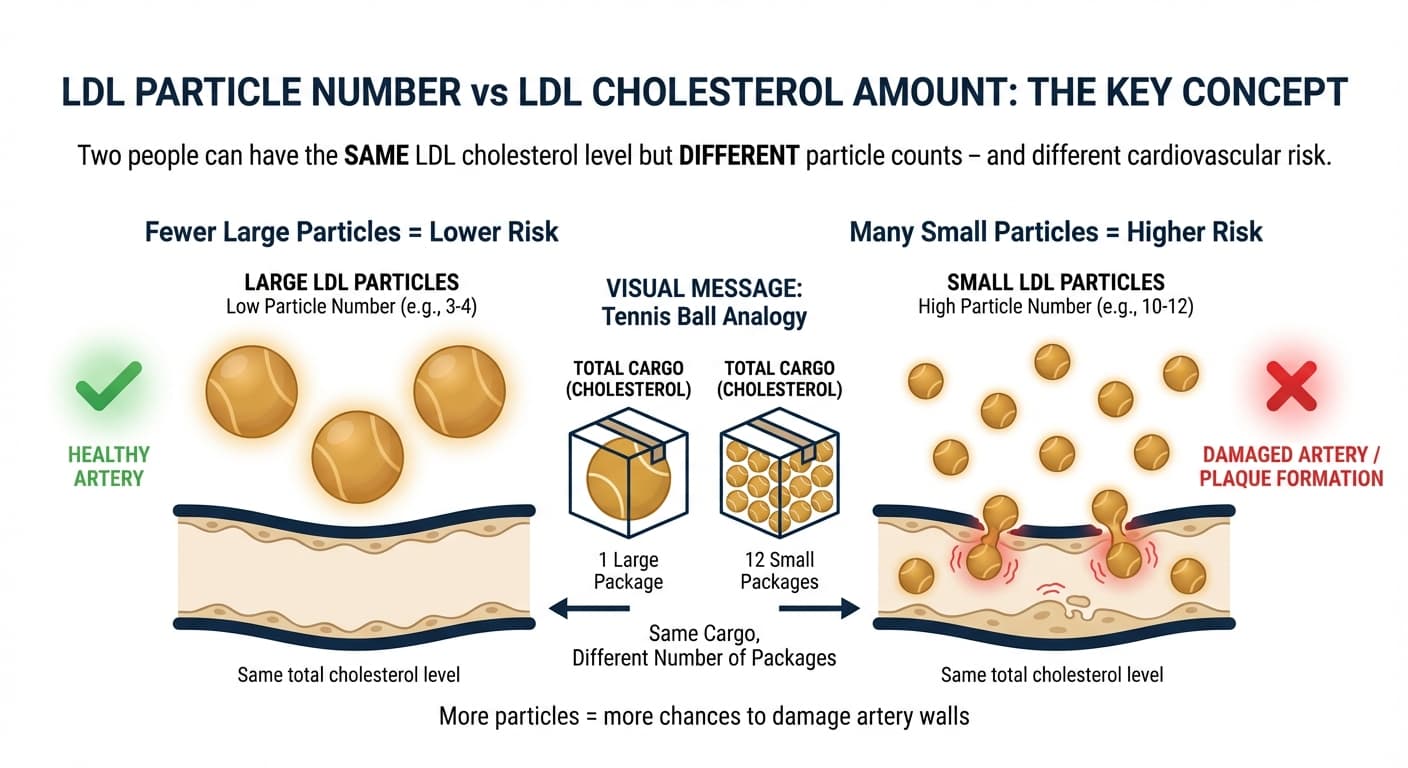
Two people with identical LDL-C levels can have vastly different cardiovascular risk depending on their LDL particle number.
What Advanced Lipid Testing Reveals
Advanced lipid panels examine 15 or more markers. Here are the most important ones:
LDL Particle Number (LDL-P)
This tells you how many LDL particles are circulating, not just how much cholesterol they carry. Research shows LDL-P is a better predictor of cardiovascular events than LDL-C.
What it means:
- High LDL-P with normal LDL-C = higher risk than expected
- Low LDL-P with elevated LDL-C = lower risk than expected
LDL Particle Size
LDL particles come in different sizes:
- Large, buoyant LDL - less likely to penetrate artery walls
- Small, dense LDL - more likely to cause atherosclerosis
A pattern of predominantly small, dense LDL (Pattern B) carries higher cardiovascular risk than large, buoyant LDL (Pattern A).
Lipoprotein(a) - Lp(a)
This is one of the most important markers that standard panels completely miss.
Lp(a) is genetically determined - you're born with your level, and it doesn't change much with diet or lifestyle. About 20% of the population has elevated Lp(a), which significantly increases cardiovascular risk.
Why it matters:
- It's inherited - if you have it, your children might too
- It's not affected by statins
- It requires specific treatment approaches
- It can explain "unexplained" heart attacks in young people
If you have a family history of early heart disease, elevated Lp(a) could be the missing piece of the puzzle.
Apolipoprotein B (ApoB)
Every atherogenic (artery-damaging) particle has exactly one ApoB molecule on its surface. Measuring ApoB gives you a direct count of all the particles that can potentially cause atherosclerosis.
Many lipidologists consider ApoB a better single marker than LDL-C because it captures:
- LDL particles
- VLDL particles
- Intermediate-density lipoproteins (IDL)
- Lp(a) particles
For a deep dive into ApoB and how to lower it, see my comprehensive guide on lowering ApoB for cardiovascular risk reduction.
Inflammatory Markers
Cardiovascular disease is fundamentally an inflammatory process. Advanced panels often include:
- hs-CRP (high-sensitivity C-reactive protein) - measures systemic inflammation
- Lp-PLA2 - inflammation within artery walls specifically
- Homocysteine - an amino acid linked to vascular damage
Metabolic Markers
Since metabolic dysfunction drives much cardiovascular disease, comprehensive panels may include:
- Fasting insulin - to assess insulin resistance
- Glucose - beyond standard fasting glucose
- HbA1c - average blood sugar over 3 months
Quick Reference: Key Marker Thresholds
| Marker | Optimal | Borderline | High Risk |
|---|---|---|---|
| LDL-P (nmol/L) | Under 1000 | 1000-1299 | ≥1300 |
| ApoB (mg/dL) | Under 80 | 80-99 | ≥100 |
| Lp(a) (nmol/L) | Under 75 | 75-125 | >125 |
| hs-CRP (mg/L) | Under 1.0 | 1.0-3.0 | >3.0 |
| Triglycerides | Under 100 | 100-149 | ≥150 |
Note: Optimal targets may vary based on individual risk factors. These are general guidelines.
When Should You Consider Advanced Lipid Testing?
Advanced lipid testing is particularly valuable if you have:
- Family history of early heart disease (before age 55 in men, 65 in women)
- Personal history of cardiovascular events despite "normal" cholesterol
- Metabolic syndrome or insulin resistance
- Cholesterol that doesn't respond to treatment as expected
- Discordance between risk factors and standard lipid values
- Desire for a complete cardiovascular risk picture
Not sure if any of these apply to you? Read more about signs you should see a lipid specialist.
The Integrative Approach to Lipid Management
Understanding your advanced lipid profile allows for truly personalized treatment. Instead of the one-size-fits-all approach of "cholesterol is high, take a statin," we can target specific issues:
For elevated LDL particle number:
- Dietary modifications (specific to particle type)
- Targeted supplements (omega-3s, plant sterols)
- Lifestyle interventions
- Medication when necessary
For elevated Lp(a):
- Niacin (in specific forms)
- PCSK9 inhibitors (if very high)
- Aggressive management of other risk factors
- Family screening
For small, dense LDL pattern:
- Carbohydrate and sugar reduction
- Metabolic optimization
- Addressing insulin resistance
For inflammation:
- Anti-inflammatory nutrition
- Addressing root causes (gut health, chronic infections)
- Targeted supplementation
- Stress management
Getting Started with Advanced Lipid Testing
If you're ready to look beyond standard cholesterol testing, here's what to expect:
- Comprehensive consultation to understand your health history and risk factors
- Advanced lipid panel ordered through specialized laboratories
- Detailed results review explaining what each marker means for you
- Personalized treatment plan targeting your specific lipid abnormalities
- Follow-up testing to monitor your response to treatment
The Bottom Line
Standard cholesterol testing served us well as a screening tool, but we now have access to much more sophisticated diagnostics. If you're serious about preventing heart disease - especially if you have family history or other risk factors - advanced lipid testing provides information that can genuinely change your treatment approach and outcomes.
As a board-certified clinical lipidologist, I've made it my specialty to understand these complex tests and translate them into actionable treatment plans. Whether you're looking for natural approaches, want to understand if medication is truly necessary, or need to optimize your current treatment, advanced lipid testing is the first step.
Schedule a consultation to discuss whether advanced lipid testing is right for you.
Related Articles
- I'm Now a Board-Certified Clinical Lipidologist — What my DABCL certification means for your cardiovascular care
- Signs You Need a Lipid Specialist — 5 situations where seeing a lipidologist makes sense
- Lowering ApoB: Your Step-by-Step Guide — A comprehensive guide to reducing cardiovascular risk through ApoB management