Your primary care doctor is essential for your overall health. They know your history, coordinate your care, and handle a wide range of conditions. But when it comes to complex cholesterol and lipid issues, you might benefit from seeing a specialist.
As a board-certified clinical lipidologist (DABCL), I've seen many patients who struggled for years with their cholesterol before realizing that specialized care could make a significant difference. Here are five signs that it might be time to see a lipid specialist.
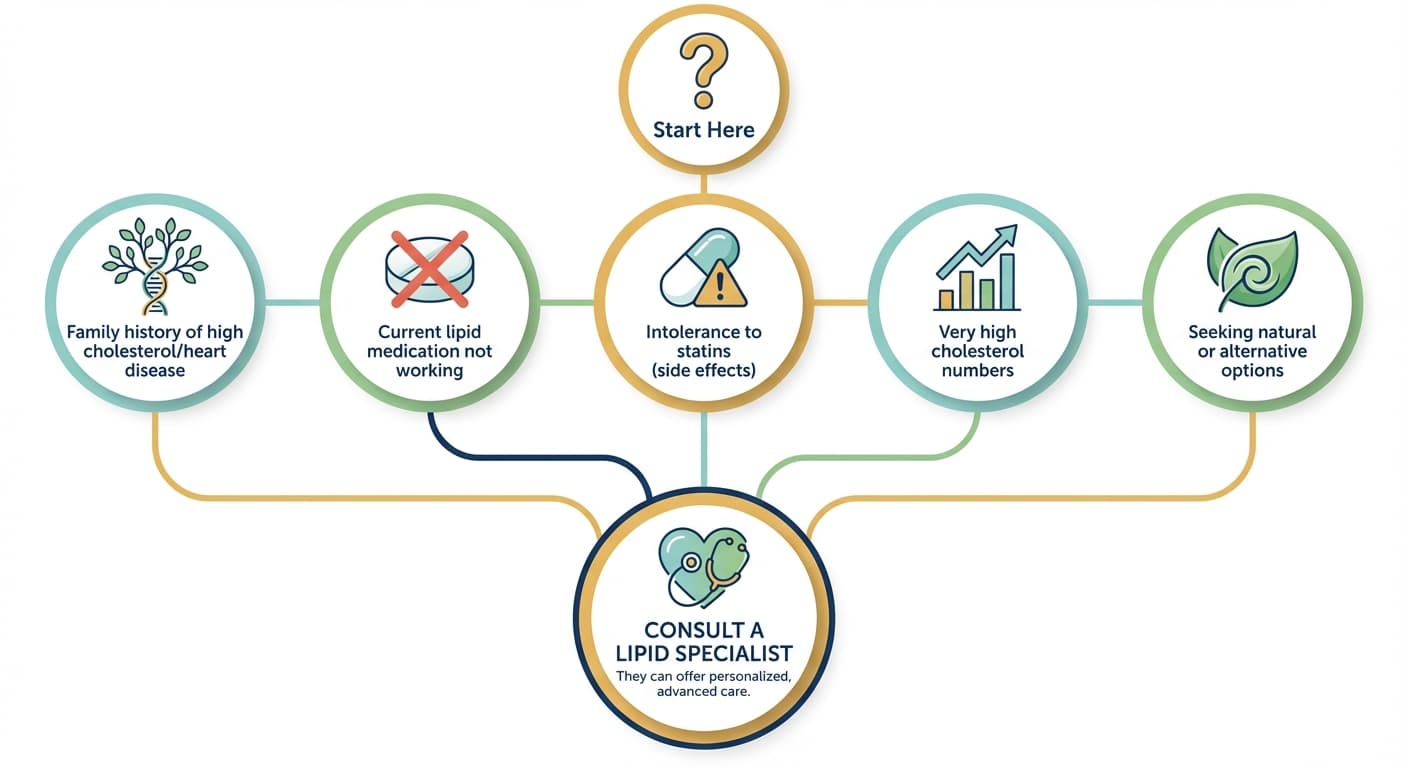
1. You Have a Family History of Early Heart Disease
This is one of the most important red flags that often gets overlooked.
What counts as "early" heart disease?
- Heart attack, stroke, or cardiovascular procedure before age 55 in men
- Heart attack, stroke, or cardiovascular procedure before age 65 in women
If your parent, sibling, or grandparent had a cardiovascular event at a young age, you may have inherited genetic factors that increase your risk - factors that a standard cholesterol panel won't detect.
What a lipidologist can do:
- Order advanced lipid testing to identify genetic risk factors like elevated Lp(a)
- Screen for familial hypercholesterolemia (FH), which affects 1 in 250 people
- Create an aggressive prevention plan tailored to your genetic risk
- Recommend screening for your family members
Many people with familial hypercholesterolemia don't know they have it until they have a cardiac event. A lipidologist can identify this condition before it causes problems.
2. Your Cholesterol Isn't Responding to Treatment
You've been taking medication faithfully. You've changed your diet. You exercise regularly. But your cholesterol numbers haven't budged - or they've barely improved.
This is more common than you might think, and there are many reasons why:
Possible explanations:
- You may have a genetic condition that requires more aggressive treatment
- Your medication dose may need optimization
- The type of medication may not be right for your specific lipid pattern
- Secondary causes (thyroid issues, kidney problems) may be interfering
- Your diet changes may not be targeting the right factors for your profile
What a lipidologist can do:
- Dig deeper with advanced testing to understand why treatment isn't working
- Identify secondary causes that may be contributing
- Optimize medication selection and dosing
- Identify dietary and lifestyle factors specific to your lipid abnormalities
- Consider combination therapies when single agents aren't sufficient
Sometimes the solution is simple - the wrong approach was being taken for your specific type of lipid problem. Other times, it requires a completely different strategy.
3. You Can't Tolerate Statins
Up to 10-20% of patients experience statin side effects that make these medications difficult or impossible to take.
Statins are the most commonly prescribed cholesterol medications, but this significant percentage of patients struggle with tolerability.
Common statin-related complaints include:
- Muscle pain, weakness, or cramping
- Fatigue
- Memory issues or "brain fog"
- Digestive problems
- Joint pain
Many patients are told to "just deal with it" or are switched from one statin to another without improvement. But statin intolerance is a recognized medical issue that deserves specialized attention.
What a lipidologist can do:
- Determine if your symptoms are truly statin-related (sometimes they're not)
- Try different statins or dosing strategies (some are better tolerated than others)
- Identify the lowest effective dose for your specific needs
- Explore non-statin medications (PCSK9 inhibitors, ezetimibe, bempedoic acid)
- Develop natural and lifestyle-based approaches to reduce medication needs
- Use advanced testing to determine if you truly need aggressive LDL lowering
As a naturopathic doctor AND a lipidologist, I specialize in finding the right balance between medication and natural approaches. Many of my patients are able to achieve their goals with lower doses or fewer medications than they were originally prescribed.
4. You Have Very High LDL or Triglycerides
Certain lipid levels are high enough to suggest an underlying genetic condition or secondary cause that requires specialist evaluation.
When to See a Specialist: Key Thresholds
| Marker | Threshold | What It May Indicate |
|---|---|---|
| LDL cholesterol | >190 mg/dL | Familial hypercholesterolemia |
| Triglycerides | >500 mg/dL | Pancreatitis risk, genetic component |
| HDL cholesterol | Under 30 mg/dL | Metabolic or genetic conditions |
| Family history | Heart disease before 55 (men) or 65 (women) | Inherited cardiovascular risk |
| Lp(a) | >50 mg/dL or >125 nmol/L | Genetic risk factor |
| Any lipid abnormality | Appearing in childhood | Almost always genetic |
These aren't just "high cholesterol" - they're signals of specific conditions that require targeted treatment. Learn more about what advanced lipid testing can reveal.
What a lipidologist can do:
- Properly diagnose genetic lipid disorders
- Implement appropriate treatment protocols (which differ from standard high cholesterol)
- Coordinate care if advanced therapies are needed
- Arrange family screening when genetic conditions are identified
- Monitor for complications specific to these conditions
Familial hypercholesterolemia, for example, requires lifelong treatment and often needs multiple medications. Severe hypertriglyceridemia requires urgent dietary intervention to prevent pancreatitis. These situations benefit enormously from specialized care.
5. You Want to Understand Your Options Beyond Medication
Maybe your doctor has recommended a statin, but you want to explore whether lifestyle changes or natural approaches might work first. Or perhaps you're already on medication but wonder if you really need it.
These are valid questions, but your primary care doctor may not have time to thoroughly explore alternatives with you.
What a lipidologist can do:
- Use advanced testing to determine your true cardiovascular risk (not just LDL-C)
- Identify which patients truly need medication vs. those who might do well with lifestyle changes
- Create evidence-based natural treatment plans (not just "eat better and exercise")
- Target specific interventions to your lipid abnormalities
- Monitor progress with sophisticated testing to ensure natural approaches are working
- Know when to recommend medication - and when it's safe to try without it
As a naturopathic doctor, I'm trained in natural and lifestyle medicine. As a board-certified lipidologist, I understand when those approaches are sufficient and when conventional medication is truly necessary. This combination allows me to help patients find the right balance for their specific situation.
For a detailed look at how to lower one of the most important markers, see my guide on lowering ApoB for cardiovascular risk reduction.
What Makes a Lipidologist Different?
Board-certified clinical lipidologists (DABCL) have completed extensive additional training beyond medical school and residency. We've passed a rigorous examination and maintain our certification through ongoing education.
We specialize in:
- Complex lipid disorders
- Advanced lipid testing interpretation
- Genetic lipid conditions
- Cardiovascular disease prevention
- Non-statin therapies
- Lifestyle and dietary approaches to lipid management
While primary care doctors see patients with hundreds of different conditions, lipidologists focus specifically on lipid disorders and cardiovascular prevention. We see the unusual cases, the treatment failures, and the complex genetic conditions.
How to Get Started
If any of these signs resonate with you, here's what I recommend:
-
Gather your records - Bring your previous lipid panels, any imaging studies, and a list of medications you've tried
-
Know your family history - Ages of any cardiovascular events in parents, siblings, or grandparents
-
List your concerns - What symptoms have you experienced? What treatments haven't worked? What are your goals?
-
Schedule a consultation - We'll review your history, order appropriate advanced testing, and create a personalized plan
Remember, seeing a specialist doesn't replace your primary care doctor - it enhances your care team. I work collaboratively with primary care physicians to ensure coordinated, comprehensive treatment.
The Bottom Line
Complex cholesterol issues deserve specialized expertise. If you've been struggling with any of the five signs above, a board-certified lipidologist can provide the focused attention and advanced testing needed to finally get answers - and results.
Ready to take the next step? Schedule a discovery call to discuss whether specialized lipid care is right for you.
Related Articles
- I'm Now a Board-Certified Clinical Lipidologist — What my DABCL certification means for your cardiovascular care
- Beyond Standard Cholesterol Testing — What advanced lipid panels reveal that standard tests miss
- Lowering ApoB: Your Step-by-Step Guide — A comprehensive guide to reducing cardiovascular risk through ApoB management